hill.camp does not test products first-hand. This review is a structured synthesis of eight independent sources — specialist field tests from the US and French trail running press, a two-tester long-form review, and verified owner feedback from a French forum and Reddit — assembled with AI assistance and edited before publication. Sources are selected and verified by runners who follow this equipment closely. That process surfaced a genuine split of opinion on stability, midfoot hold and underfoot protection, which we’ve flagged openly below rather than smoothing it over.
Nike named its Zegama after one of the most technical races in trail running, and for two generations the shoe struggled to earn the name. This Nike ACG Zegama Trail review asks whether the third edition finally does. It arrives with a wider platform, a roomier last, a redesigned layered upper, ZoomX foam stabilised by a firmer Cushlon 3.0 rim and an unchanged $180 / €170 price. Across eight sources, agreement is striking on some points: the Vibram Megagrip traction is excellent, the comfort is high, and the shoe is heavy. Where they split, and split hard, is on the thing Nike leans on most in its marketing: how secure and stable the shoe feels once the terrain turns technical.
Scores show the divide. They run from 5/10 in a single owner review on a French forum to 9.5/10 from one tester at a US multi-tester review, with a US outdoor-gear lab landing at 4.4/5 and a US shoe-review site awarding its top S tier. That spread is the story of this shoe.
| Spec | Detail |
|---|---|
| Price | $180 MSRP; about €170 in Europe (€169.90–169.99 in retail listings); GORE-TEX version listed around €189.90 |
| Release | April 30, 2026 (US) |
| Weight | About 336–338 g / 11.8–11.9 oz (men’s US 10); about 312–315 g (men’s US 9, two testers’ scales); about 273–274 g / 9.6 oz (women’s US 8–8.5) |
| Stack height / drop | 38 mm heel / 34 mm forefoot, 4 mm drop (Zegama 2: 36/32 mm, 4 mm) |
| Platform width | 100 mm heel / 85 mm midfoot / 125 mm forefoot, as measured by one tester (Zegama 2: 95/85/115 mm) |
| Midsole | ZoomX top layer over Cushlon 3.0 layer with firmer stability rim; forefoot « wings »; no carbon plate or rock plate |
| Upper | Multi-layer perforated mesh, sock-like gusseted liner, woven midfoot band, elastic gaiter-style ankle collar with heel finger loop |
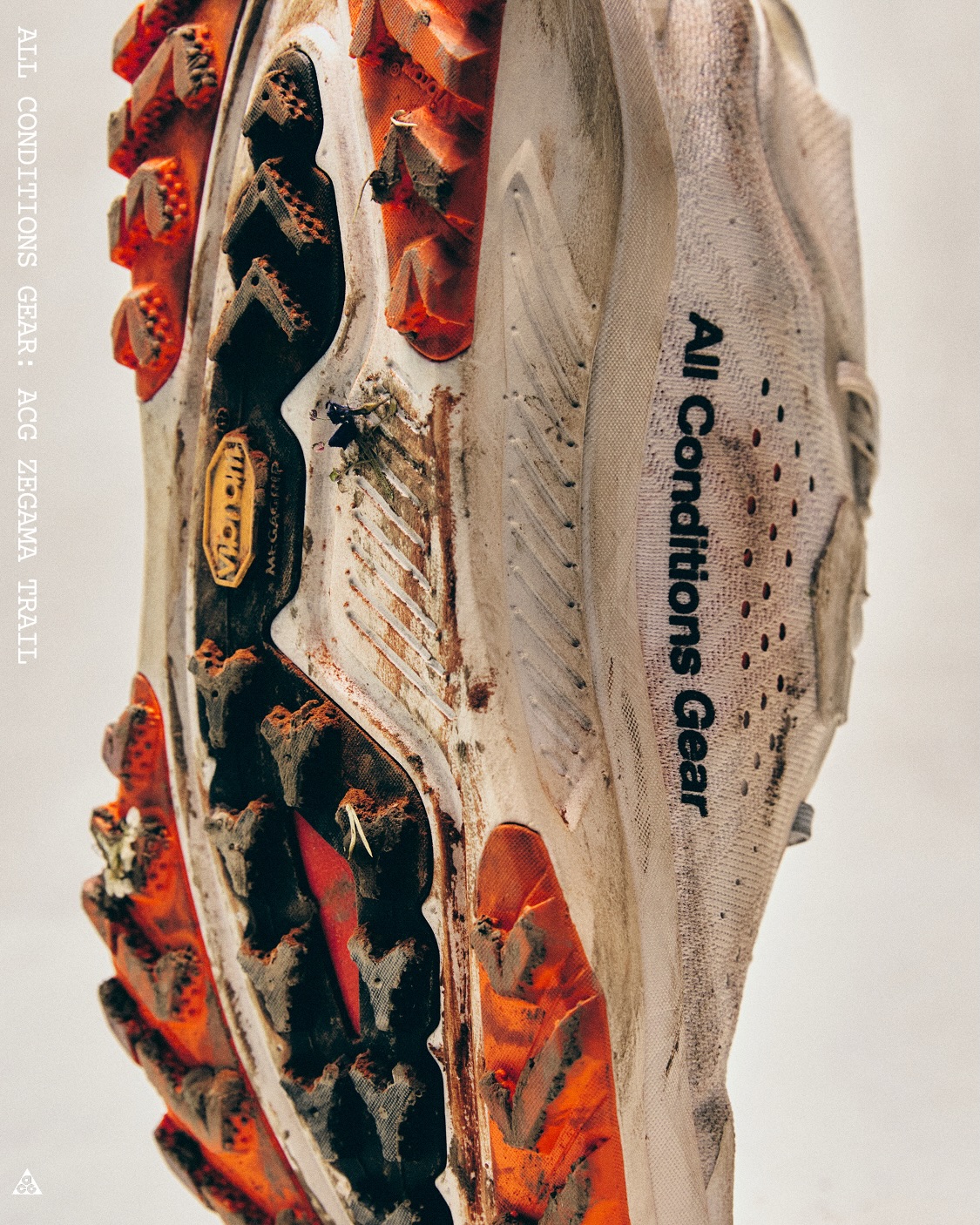
| Outsole | Vibram Megagrip with Traction Lug technology; partial rubber coverage with exposed midsole foam; lugs reported at 4 to 5 mm depending on source |
| Sizing | Unisex sizing; true to size for most testers, with caveats for wide forefeet |
| Best for | Comfort-first long days, high-mileage training and non-technical to moderately technical ultras |
A few small factual discrepancies are worth knowing before you compare spec sheets. Lug depth is quoted as 4 mm, 4.5 mm and 5 mm by different sources. One tester puts the weight gain over the Zegama 2 at 15 to 18 g, while another says nearly an ounce. And while three sources describe a slight or smooth forefoot rocker, one tester explicitly says the shoe has none.
What Changed From the Zegama 2, and What the Name Means
First, the naming. This is the third generation of Nike’s Zegama, but Nike calls it the ACG Zegama Trail rather than the Zegama 3. It is also a separate shoe from the ACG Zegama Hike, which is built for hiking with minor construction differences, and GORE-TEX versions are sold too, though only one Reddit commenter’s first impressions of one appear in our sources.
Compared with the Zegama 2, the changes are broad: a stack 2 mm taller, a wider platform, more ZoomX with a firmer Cushlon 3.0 layer and rim, forefoot wings, a new layered upper with a redesigned collar, a roomier last and a redeveloped lug pattern. Testers who knew the earlier versions describe a shoe that finally fixes the upper and fit problems of the first two generations. One US tester argued bluntly that neither earlier version would have coped with the very race that inspired their name.
Ride and Cushioning: Plush or Firm? Both, Apparently
On the basics, the sources agree. This is a high-stack, neutral shoe built around a thick ZoomX layer, with Cushlon 3.0 underneath and around it to keep the soft foam in check. Nike claims the ZoomX 3.0 formulation returns 85% of impact energy, a figure relayed by one source and not independently measured. There is no carbon plate, which puts the Zegama Trail in the opposite camp from the debate in our guide to carbon plate trail shoes. Instead, the forefoot wings widen the contact area, though one tester admitted it was hard to say whether they made a difference.
The sensation, however, depends on who you ask. One tester at the multi-tester review found the ride firm yet comfortable, explicitly not the cloud-like feel of a La Sportiva Prodigio Pro. A US gear-lab pair described the ZoomX as plush and bouncy and scored cushioning 4.5/5. A Runner’s World tester liked a balance that is soft enough to protect her feet but not, in her words, « mashed potatoes ». At the other end, the French forum reviewer found the maximal cushioning so isolating that he felt almost nothing of the ground, and by his own account, as someone who prefers firm shoes, he didn’t enjoy it. By contrast, the US gear-lab pair said they got more trail feel than they expected.
Nobody calls it a fast shoe. A French field test found it comfortable and protective but not the most dynamic, and steered anyone wanting snappier acceleration toward the Ultrafly. One tester called the ride dependable but not thrilling and hoped for more fun in the next version. Others were kinder: the US shoe-review site described a carefree, bounding ride on moderate terrain, and the ultrarunning-magazine tester felt the shoe hit a sweet spot between cushion and energy return.
Underfoot protection is a genuine contradiction. The two testers at the multi-tester review scored rock protection 9.8/10 and 10/10. The US gear-lab pair reported the opposite: despite the thick foam, sharp rocks made themselves felt under the forefoot on a five-mile descent of rock-strewn doubletrack, and they noted the absence of a rock plate. The French forum reviewer also found the front rock guard fairly light. Different terrain, different feet and different expectations may explain part of it, but if your local trails are seriously rocky, treat the « great protection » claims with caution.
Stability and Foot Hold: The Sharpest Disagreement in This Review
This is where the sources genuinely split, and it matters because stability is the core of Nike’s pitch. On one side, a majority of testers describe a planted, secure shoe. One tester compared it to riding in a monster truck that nothing can knock off course, and said it was the shoe that gave him the most confidence on descents of any he’d run. A Runner’s World tester found the revised last and cupped fit crossing into stability-shoe territory. The ultrarunning-magazine tester stayed solidly stable on scree and class 3 scrambling. A US shoe-review site called the fit improvement massive over earlier versions, and the French test in Chamonix singled out foot hold and stability on technical trails as strengths. On Reddit, a heavy walker reported no lateral instability on uneven ground after a month of use, and several heavier commenters described it as a staple.
Two sources reached close to the opposite conclusion. The US gear-lab pair rated stability 3.5/5, found the new wider fit sloppier through the midfoot than the old Zegama X, never achieved a lock-in feel despite trying different lacing, and found their feet sliding and the shoe more prone to rolling on uneven ground. They also disagreed openly with Nike’s positioning of the shoe as highly technical. The French forum reviewer was harsher still: he called the foot hold catastrophic, said his foot moved in every direction despite good lacing, described the ankle as unsupported and the heel as soft, and reported that his feet suffered more over 15 km than over a 75 km outing three weeks earlier. He added that the rest of his group, who also tried the shoe, reached the same conclusion.
Can anything reconcile these reports? Lacing may be part of it. One US tester had alarming heel slippage on his first hike until he used the upper eyelets and cinched the midfoot, and another tester says you need to tighten the laces very tightly and use the top eyelet to unlock the shoe, admitting it feels almost painful at first. But foot shape doesn’t explain the split neatly: a narrow, flat-footed tester loved the hold, while an average-volume tester with a slightly narrow heel found the midfoot too roomy, and the forum reviewer says his feet are medium width. Our reading: if you buy this shoe for moderate terrain, lockdown is probably fixable with the right lacing. If you’re buying it for steep, off-camber, technical ground, take the skeptical reports as seriously as the glowing ones, and try before you commit.
Fit and Sizing
Sizing is mostly straightforward. Testers at the multi-tester review found it true to size in length, the forum reviewer took his usual size 45 and found the length right, and a US shoe-review site says the new last is noticeably roomier through the forefoot and midfoot than previous versions. Several sources praise the toe box: one calls it roomy enough to wiggle your toes, the ultrarunning magazine notes a taller toe box that accommodates swelling, and a Reddit user who mostly wears minimalist shoes called the toe space phenomenal.
Width is where it gets contradictory. One of the two US gear-lab testers, with wider feet, found the forefoot somewhat narrow in her usual women’s 8.5 and felt pressure on steep climbs, and the lab suggests wide-footed runners consider a half size up or look elsewhere. A Reddit commenter also found his pair too narrow, and another reports the toe box slightly narrower than an Altra’s. Meanwhile the forum reviewer suggested very wide-footed runners might get on better with the shoe than he did. Step-in is easy thanks to a large finger loop stitched into the heel, according to one tester. The laces are extremely long, and one tester wished for a lace garage.
Upper, Collar and Breathability
The upper is one of the shoe’s most distinctive elements. Through the midfoot there are three layers: a perforated outer mesh, a thick perforated reinforcement and a thinner inner layer that doubles as a tongue gusset. The forefoot uses only the outer and inner layers with light toe overlays. A US tester says support wings and a semi-bootie sit sandwiched between the layers. A gaiter-style collar rises high at the rear, with a loop that would allow a full gaiter to be attached. Testers who ran through deep sand, gravel and grit report that it kept out nearly everything, although the US gear lab notes it is no substitute for a true gaiter on particularly loose terrain.
Breathability is well liked across the board. One tester ran in the low 80s °F without the shoe running hot, the mesh dried quickly after a surprise rainstorm, and the forum reviewer says it evacuates moisture well. Runner’s World adds that it vents well without being so airy that feet freeze in brutal cold. The one open question is durability of the open mesh, covered below.
Traction and Outsole
Traction is the most consistently praised feature. Both testers at the multi-tester review scored it 10/10, one calling it among the best outsoles he’s tried in recent years, with grip on dust, scree, roots and mud and no sticky feel on pavement, unlike the NNormal Tomir 2.0. A Runner’s World tester said the lugs dig deep without packing with mud, and the US shoe-review site had zero slippage, crediting microtraction nubs on the lug sides. A Reddit commenter reported excellent grip on frozen snow and another used the shoe in a muddy ultra earlier this year, noting the lugs are bigger and more aggressive than on the Zegama 2. If you want to know why so many brands choose this outsole, our Vibram Megagrip guide explains it.
Not everyone agrees it is class-leading. The US gear lab rated traction 4/5, calling it good rather than exceptional: rubber coverage is partial, with exposed midsole foam under the midfoot and along the sides, the heel chevrons are not especially aggressive, and on long, steep descents the bite falls short of more mountain-focused shoes like the La Sportiva Prodigio or the Hoka Mafate. The French forum reviewer found the grip correct but nothing more, and said the shoe slipped quite a bit in mud, though less than an Ultrafly, and nowhere near his La Sportiva Cyclon. Runner’s World flagged a split in the lug pattern around the heel that telegraphs through on steep downhills. The partial rubber coverage isn’t an oversight: several testers say it saves weight and adds flexibility, and one felt it kept him in control of the shoe rather than the other way around.
One more note. Three sources say the Zegama 2 already used Vibram Megagrip, while the US gear lab frames it as a meaningful upgrade in this version. The majority view is that the compound is unchanged and the pattern is what’s new.
Weight: Heavy on Paper, Forgotten on the Trail?
Every source agrees the Zegama Trail is heavy. One US site lists lighter max-cushion rivals: the Salomon S/Lab Ultra Glide 2 at about 320 g, The North Face Vectiv Enduris 4 at 310 g, the Kiprun Kipsummit Max at 298 g and the Hoka Mafate 5 at 332 g, against the Zegama’s roughly 337 g. The US gear lab notes that the Hoka Speedgoat and even the hiking-oriented Altra Lone Peak 9 undercut it. What differs is how much it matters. Four testers say they stopped noticing the weight once running, crediting the comfort it buys. One tester at the multi-tester review lists it as a real con, placing it near the heaviest shoes on the market, and the US shoe-review site says it was the only thing that made it second-guess an S tier for design.
Durability
Early reports are positive, but nobody has long-term mileage on this exact shoe. The US gear lab had about 70 miles with the midsole and collar unmarked apart from small cosmetic nicks, while the ultrarunning magazine’s pair showed no unusual wear after around 100 miles. The upper is the concern: the US lab worries the large mesh perforations and light reinforcement leave the sides exposed to tears, while the ultrarunning magazine says the new layered mesh solves an area of early breakdown in previous versions. A Reddit commenter’s two Zegama 2 pairs each lasted five to six months of heavy use with tears near the big toe, and he hopes the new material fixes that. White and light colorways show every bit of dirt, a point raised by both a Reddit commenter and the US lab.
Nike ACG Zegama Trail vs the Competition
The Zegama Trail’s competitive set is the all-day, high-stack workhorse. Against the Hoka Speedgoat, two testers reached similar conclusions on different versions. One called the Speedgoat 6 a close call, with the Nike smoother and better at keeping debris out, and the Hoka lighter with a better upper and lacing. The US gear lab, comparing the Speedgoat 7, found the Hoka more stable, better locked-down and more protective, while the Zegama is softer, more flexible and more fun to run. If you’re weighing that shoe against other classics, see our Speedgoat vs Speedcross comparison and Norda 001 vs Speedgoat.
Against the Brooks Cascadia, sources agree on personality more than a winner. The Cascadia 19 feels more stable, protective and firmer but more plodding at pace, while the Zegama is lighter on its feet and more flexible. The Cascadia 20 is a touch lighter at 260 g and $20 cheaper, with a similar 38/32 mm stack, while the Zegama may have the more breathable upper and better debris collar. Versus the La Sportiva Prodigio Pro, one tester found the Sportiva softer and less stable at the heel, and could imagine wearing it early in an ultra before switching to the Zegama when focus fades. Against the S/Lab Ultra Glide from Salomon, the same tester found the Nike more versatile and playful, but would pick the Salomon for relatively non-technical 100-mile races.
The same tester judged the Zegama better than the NNormal Tomir 2.0 in nearly every way, with more cushioning and stability, and no glued-to-the-ground feel on hard surfaces; our NNormal Tomir 02 review covers the other side of that comparison. For the maximal end of the market, our Hoka Mafate 5 review is the obvious companion read, since one source found the Mafate bites better on steep descents. Finally, the US gear lab preferred the firmer, lower Topo MTN Racer for tight technical terrain, and the Saucony Xodus Ultra 4 is a slightly narrower, more agile alternative with a similar Vibram outsole.
Where It Sits in the ACG Range
Sources place the Zegama Trail as the max-cushion workhorse of ACG’s trail line-up, between the lighter Pegasus Trail and the race-ready Ultrafly. The ultrarunning magazine notes it shares the Ultrafly’s ZoomX compound and a comparable stack, but without the full-length carbon plate, and with a sturdier, more padded upper focused on comfort and stability. The Ultrafly is for speedsters, in its words, while the Zegama is for the rest of us who want to reach the finish in comfort. Nike’s next big step is the announced late-2027 Nike ACG Picklejus, which Nike positions as the top end of its footwear business, so the Zegama Trail reads as the accessible workhorse below it.
Who Should Buy It, and Who Should Wait
The Zegama Trail makes sense for runners who spend most of their time on moderate trails and want one comfortable shoe for everything from easy aerobic miles to big-mileage days, including hikers who value a cushioned all-day shoe. It is a strong candidate for muddy training and for long efforts where dependable comfort matters more than weight; one tester at the multi-tester review sees it as a plausible 100k or 100-mile shoe for that reason, and the ultrarunning magazine calls it equally suited for 100-mile racing or high-mileage training. Note that nobody in our set reports actually running a 100-miler in it: the longest efforts described are a five to six hour long run and multiple 12-mile-plus outings.
Wait, or try before you buy, if you run on steep, rocky, technical ground; if you have a wide forefoot; or if you want a fast shoe for racing. Two sources suggest a plated shoe or a firmer, lower-slung shoe for those jobs instead.
Our Take
The Nike ACG Zegama Trail is a good shoe with one contested trait. On grip, comfort, ventilation and the useful ankle collar, the sources are close to unanimous, and it fixes the fit and upper problems that held earlier Zegamas back. Where we’d push back on the more enthusiastic coverage is the idea that stability and foot hold are simply solved: two independent, detailed reports, one from a two-tester gear lab and one from a group outing on a French forum, describe a sloppy midfoot, a soft heel and rolling ankles, and they contradict the « monster truck » testimony. The protection question, with perfect scores at one outlet and forefoot bruising at another, deserves the same skepticism. We’d treat it as a comfort-first all-rounder rather than the mountain specialist Nike’s marketing suggests, and we wouldn’t buy it online sight unseen if you have wide feet or truly technical trails.
On value, $180 is fair for the build and components, and one price tracker showed it already below MSRP at some retailers on September 21. If you try it in a shop, lace it with the heel-lock eyelets and give your usual downhill a proper test before deciding which camp you fall into.
Nike ACG Zegama Trail Review: Frequently Asked Questions
Is the Nike ACG Zegama Trail true to size?
For most testers, yes in length. Width is less clear: several praise the roomy toe box, but a wider-footed tester found the forefoot narrow and the US gear lab suggests a half size up for wide feet. A Reddit commenter also found his pair too narrow, so trying it on is safer than assuming.
Is the ACG Zegama Trail good for technical terrain?
This is genuinely contested. Several testers describe outstanding stability on scree, scrambles and technical descents, while a two-tester US gear lab and a French forum reviewer report a sloppy midfoot and poor foot hold. Lacing tightly with the top eyelet helps, and technical-terrain buyers should weigh both camps.
How does the ACG Zegama Trail compare with the Zegama 2?
It has a 2 mm taller stack, a wider platform, more ZoomX plus a Cushlon 3.0 rim, a redesigned upper and collar, a roomier last and a redeveloped lug pattern. It is also heavier, by 15 to 18 g according to one tester and nearly an ounce according to another. Testers who knew the earlier versions consider it a big improvement.
Is the Zegama Trail good for 100-mile races?
Two sources call it suitable, especially for runners who value durable comfort over low weight. However, none of our testers reports running a 100-miler in it, and heavier weight and possible foot-hold issues are the main caveats.
What is the difference between the Zegama Trail, Zegama Hike and Zegama Trail GTX?
The Zegama Trail is the trail-running shoe, while the Zegama Hike is designed for hiking with minor construction differences. GORE-TEX versions of the Trail are also sold, listed around €189.90 at one retailer, but none of our sources tested one at length.
Is the ACG Zegama Trail too heavy?
It is heavy, at about 337 g in a men’s US 10, and heavier than most max-cushion rivals. Several testers say they stopped noticing it while running, but if you want a lighter shoe for the same job, the Hoka Speedgoat is a clear alternative.
This Nike ACG Zegama Trail review is meant as a starting point, not the final word. For full specs, sizing guidance and current availability, see Nike’s official site.