hill.camp does not test products first-hand. This preview is a structured synthesis of five independent sources — an in-person briefing report, two news write-ups, an opinionated launch-week editorial and an endurance-training analysis — assembled with AI assistance and edited before publication. Sources are selected and verified by runners who follow this equipment closely. One thing sets this piece apart from our other reviews: the Picklejus is not on sale until late 2027, so none of these sources has actually run in it. Everything below rests on Nike’s own claims and one supervised look at the shoe, and we’ve said so wherever it matters.
Nike ACG picked the busiest week in trail running to show off the Picklejus, and it made sure nobody could miss it: a shoe named after pickle juice, in an eye-searing colorway, with a rocker said to look like a pickle. Strip away the joke and this Nike ACG Picklejus preview is really about three things: a co-molded, dual-density ZoomX midsole, a hydrophobic Flyknit upper, and GOATEK, a new outsole compound Nike says is a big step up in wet grip and durability. Release is pencilled in for late 2027, there is no price, and nobody outside Nike has run in it yet. So this is part analysis, part reality check, and the reality check matters as much as the spec sheet.
| Spec | Detail |
|---|---|
| Status | Announced during UTMB week 2026; prototype stage, not yet on sale |
| Release | Late 2027 (Nike and selected retailers, per one source) |
| Price | Not announced |
| Weight | Not officially confirmed; one source reports a target of about 275 g / 9.7 oz (men’s US 10) |
| Stack height / drop | Reported by one source only: 38 mm heel / 32 mm forefoot, 6 mm drop |
| Midsole | Co-molded dual-density ZoomX supercritical foam: softer inner core, firmer outer ring; no plate, no glue layer |
| Upper | Trail-tuned Flyknit with hydrophobic yarns, knit containment cables and a gaiter-style collar |
| Outsole | GOATEK (Nike proprietary), claimed +45% wet traction and +25% abrasion resistance; lugs reported at about 5 mm |
| Testing claimed | 18,000+ miles over five long-term wear-test cycles; 10 studies, 20 prototypes, 100+ athletes |
| Best for | Big-mountain ultras of 100 miles and beyond |
What Nike Has Actually Announced
The facts every source agrees on are short. The Picklejus is the first ACG shoe to come out of the Nike Sport Research Lab, and ACG’s own framing at the launch briefing was blunt: this is the top end of its footwear business, described as a maximum-cushion proposition for that big-mountain ultra. Development reportedly drew on three years of exchanges with athletes based around Chamonix, plus 10 research studies, 20 prototypes and more than 100 testers. Emily Farina, the lab’s senior principal for running footwear, summed up the brief as « no compromises » between climbing efficiency and downhill protection.
Context helps. ACG has already shipped the Pegasus Trail, the Ultrafly 2 and the Zegama Boot this year, and a French outlet places the Picklejus above the plated Ultrafly and the Kigerfly racer prototype in the range, while openly wondering whether it will sit alongside the Ultrafly or eventually replace it. Nike hasn’t said. The briefing report is the only source to name rivals: the Salomon Ultra Glide, the La Sportiva Prodigio Pro and the Brooks Cascadia. If you want to understand those competitors’ home turf, our pages on Salomon and La Sportiva are a good start, and our Hoka Mafate 5 review shows how heated the « how much shoe is too much shoe » debate already is at the maximal end.
The Midsole: Two ZoomX Foams, No Plate, No Glue
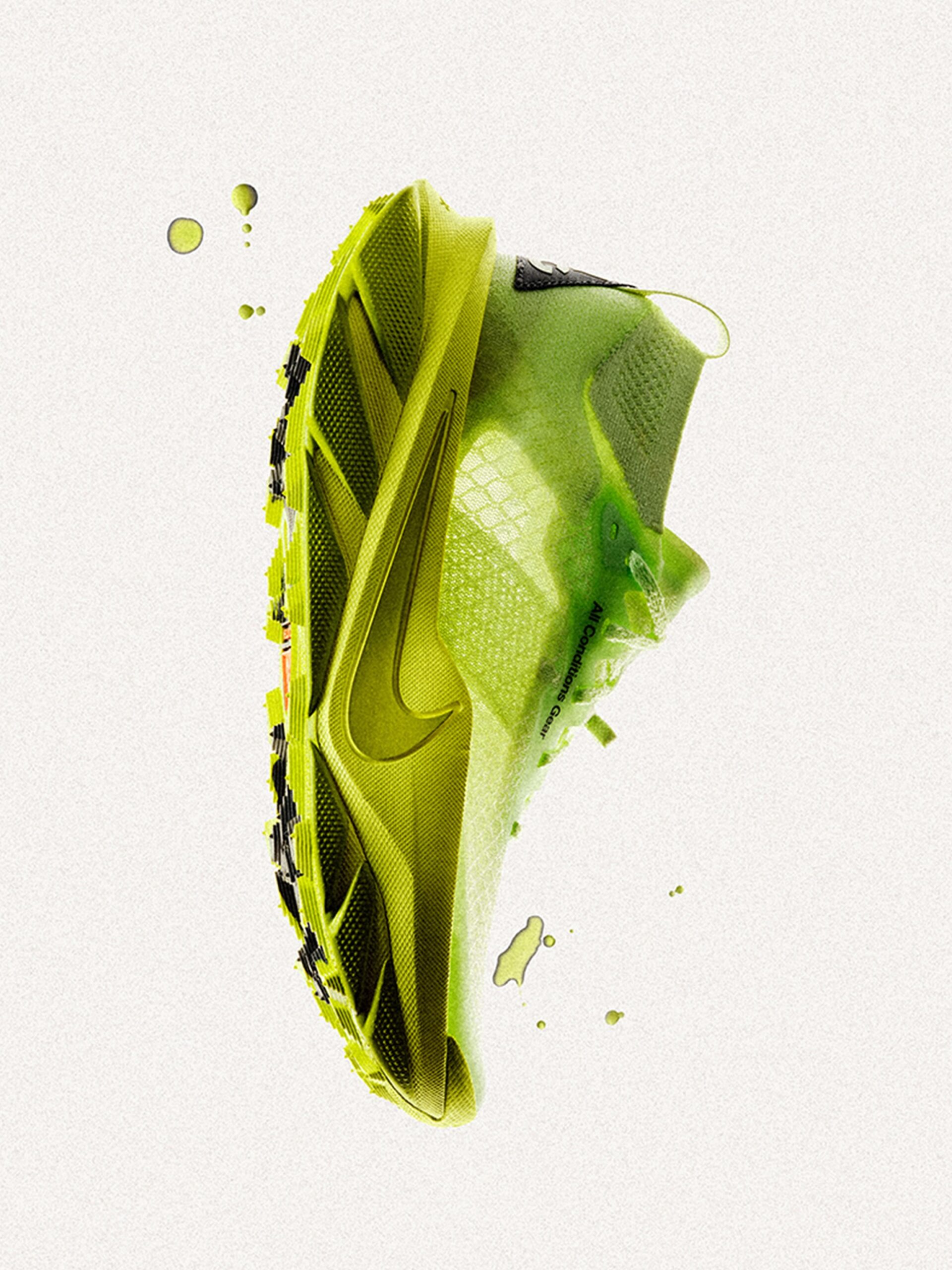
This is the part that reads like genuine engineering rather than marketing. Every source describes the same architecture: a softer ZoomX supercritical core for cushioning, wrapped in a firmer ZoomX perimeter ring, molded together in one piece. It’s a first for Nike in trail, and a first for ZoomX generally according to the briefing report. Three sources describe the firm ring as doing something close to a plate’s job, which is a stability idea rather than a propulsion one. There is no carbon plate here, which puts the Picklejus in a different camp from the debate we unpacked in our guide to carbon plate trail shoes.
The briefing report adds two details found nowhere else. Because the two foams are co-molded, there’s no glue layer, and the platform showed a touch of flex when handled. The same source also relays the numbers Nike shared in the room: a 38 mm heel and 32 mm forefoot stack, a 6 mm drop, a broad base, and a target weight of about 275 g in a men’s US 10.
What nobody can tell you is how it rides. « Soft core, firm ring » is a sensible answer to the classic ultra problem, where you want plushness at hour twenty but stability on a wet, off-camber descent. But a 38 mm plateless stack is a lot of shoe to trust on technical ground, and every stability claim we have comes from Nike’s design intent and a static look at the shoe, not from a run report.
The Upper: Built to Shed Water Weight
The upper is a trail-tuned Flyknit with knit containment cables for lockdown, hydrophobic yarns to limit water uptake, and a gaiter-inspired collar meant to keep grit and small stones out. The briefing report calls it highly breathable and drainable. The hydrophobic idea is the smart bit: water absorbed into a shoe is weight you carry for hours, and on a long wet day that adds up. Keeping debris out, meanwhile, is a blister-prevention measure as much as a comfort one.
Just as important is what the sources don’t address. None of them says how the knit will stand up to rock abrasion, which is the classic question for any knit upper. One analysis flags that runners will need to check whether the collar rubs once feet swell late in a long run. And to be clear, no source describes this upper as waterproof: hydrophobic yarns shed water, they don’t seal the shoe.
GOATEK: The 45% Question
Nike put the loudest emphasis on the outsole, and it’s the story with the most history behind it. Nike claims GOATEK delivers a 45% increase in wet traction and 25% greater abrasion resistance. The briefing report is candid about why this matters: Nike outsoles have traditionally been below par for wet grip. It recalls that the Pegasus Trail GTX used a grippier compound that Nike worried wouldn’t last, and that Nike then turned to Vibram for the Ultrafly and the latest Kiger while it worked on its own rubber. GOATEK is the result of that work, and the direct challenge to the yellow octagon we dissected in our Vibram Megagrip guide.
Now the caveats, because they are large. These are Nike’s own laboratory numbers, and they are relative. The briefing report says the comparison is against the rubber on the Nike Trail Wildhorse 10, and it states plainly that how this stacks up against Vibram is unknown. One analysis makes the same point sharply: a 45% improvement over older Nike models is not a victory over competing brands, and it cites the New Balance Hierro v9 with Vibram Megagrip and 6 mm lugs as an example of what rivals already offer, against roughly 5 mm lugs reported for the Picklejus. If the starting point was a compound with a mediocre wet-grip reputation, +45% could land anywhere from « decent » to « excellent. » Only wet rock, wet roots and mud will tell us which.
There’s also a curiosity about the testing claim. A French outlet noticed that the 18,000-mile figure quoted for the Picklejus is the same total Nike quoted when presenting the Kigerfly. That may be coincidence, or it may be a programme-wide number rather than Picklejus-specific data. Nike hasn’t clarified.
Where Our Sources Disagree
Five sources sounds like a lot, but most of them are relaying the same Nike announcement, and where they diverge it’s worth knowing exactly how. We’ve flagged each gap rather than picking a side.
- Testing mileage. Three sources quote 18,000+ miles across five long-term wear-test cycles. The briefing report instead cites 20,000 miles of athlete testing. Different tallies, or different things being counted; Nike hasn’t reconciled them.
- What GOATEK is measured against. The briefing report says the Trail Wildhorse 10’s existing rubber. Other sources say « previous ACG outsoles » or « previous all-terrain outsoles. » Those aren’t necessarily the same baseline.
- Weight, stack and drop. The briefing report gives numbers, yet also says the shoe’s weight isn’t known, while a French outlet states that Nike has communicated no weight, drop or price. We treat every figure in the spec table as unconfirmed targets.
- Colorway. One source describes a radical fluorescent yellow, another a very bright green. Photography and screens being what they are, we’ll wait for the retail pair.
The Name, the Rocker and the Colour
The name is a wink at pickle juice, the vinegary folk remedy ultrarunners swear by against late-race cramps. The very pronounced rocker is said to resemble a pickle, and the loud colorway completes the gag. In a category where shoes tend to blur into each other, we like a brand having a sense of humour, and one source even reads it as a statement against a sterile, homogenous market. But we’ll say what one analysis also points out: the naming doesn’t prove pickle juice prevents cramps, it’s simply a cultural nod to the misery of long events. It also tells you nothing about grip. Judge the Picklejus in the wet, not on Instagram.
Who the Picklejus Is For (and Who Should Wait)
On paper, this is a shoe for runners tackling long alpine ultras: high stack, protective, broad platform, water-shedding upper, aggressive outsole claims. It is not aimed at fast 30 to 50 km racing; for that end of the spectrum, a firmer plated shoe like the one in our Arc’teryx Sylan 2 review is a very different proposition. And since nothing here can be bought before late 2027, the practical advice is unglamorous: don’t build a race season around a shoe that hasn’t been run yet. If you need a proven trail shoe now, start with our 10 best trail running shoes of 2026.
When it does arrive, one analysis offers advice we’d echo: test it on the surfaces that resemble your target race, wet roots, mud and hard-packed trail, rather than trusting the headline percentages. Then check heel security, toe-box room and swelling tolerance over progressively longer runs, and introduce it gradually into your rotation.
Our Take
The Picklejus is the most interesting shoe announced in UTMB week, and the reason isn’t the pickle. A co-molded, dual-density, plateless ZoomX platform is a genuinely different answer to the ultra-runner’s dilemma, and a Nike outsole finally built to be taken seriously in the wet would be a big deal for a brand long known for the opposite. But everything we’ve read is either a lab claim or a static look at a prototype. The 45% figure has no external baseline, the stability of a 38 mm plateless stack on off-camber ground is untested, and the price, weight and true release date are all unknown. Our advice: watch it, don’t bank on it. The first real run tests, especially on wet rock and over 100 miles of outsole wear, will tell us whether GOATEK is the breakthrough Nike says it is, or simply Nike’s best rubber so far. That would still be progress, but it’s not the same thing.
Nike ACG Picklejus Preview: Frequently Asked Questions
When is the Nike ACG Picklejus release date?
Sources point to late 2027. Nike hasn’t published a firm date, and one outlet lists it as « to be confirmed. » One source says it will sell through Nike and selected authorised retailers.
How much will the Picklejus cost?
Nike hasn’t announced a price. Given the new foam architecture and proprietary outsole, expect it to sit in the premium trail bracket, but that’s an assumption, not a fact.
Does the Nike ACG Picklejus have a carbon plate?
No carbon plate has been reported. Instead, a firmer ZoomX outer ring wraps the softer core, and several sources describe it as playing a plate-like role for stability and support without a plate’s rigidity.
How much does the Picklejus weigh, and what is its stack height?
Nothing is officially confirmed. One briefing report relays a 38 mm heel and 32 mm forefoot stack (6 mm drop) and a target weight of about 275 g in a men’s US 10, while another outlet says Nike has shared no weight or drop. Treat all of it as provisional.
Is GOATEK better than Vibram?
Nobody knows yet. Nike’s claimed gains of 45% in wet traction and 25% in abrasion resistance are measured against its own earlier rubber, and the briefing report explicitly notes there’s no comparison with Vibram. Independent tests will be needed.
Is the Picklejus waterproof?
No source describes it as waterproof. The Flyknit upper uses hydrophobic yarns to limit water absorption and reduce water weight, and the briefing report calls it drainable, which is a different design goal from keeping water out.
This Nike ACG Picklejus preview is a starting point rather than a verdict; for official announcements, specifications and eventual availability, keep an eye on Nike’s official site.